Legal and At-Home Grandparent DNA Testing Services
Alternative DNA Test when an alleged father is unavailable to perform a paternity DNA test.
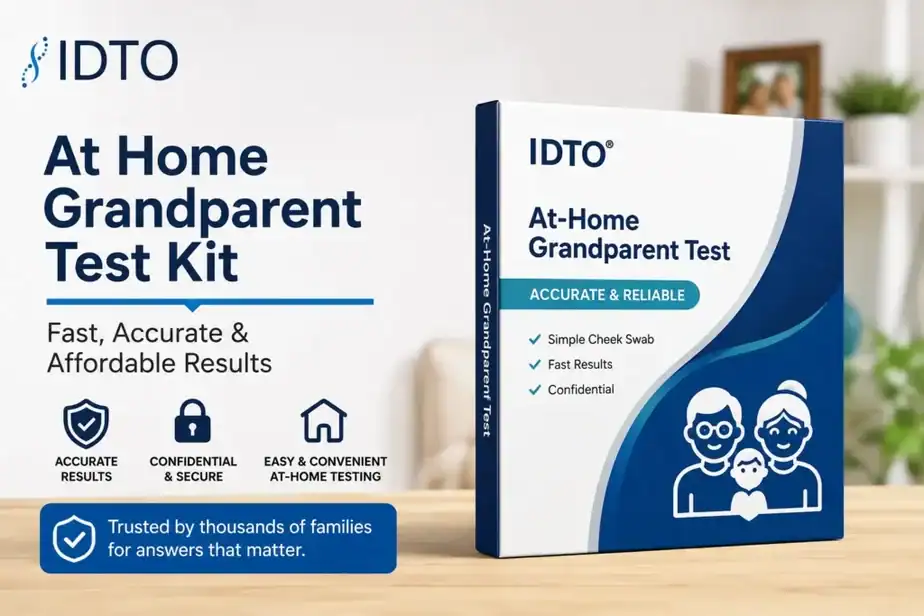
Is the alleged biological father unavailable for paternity testing? Were you adopted and need to confirm a biological relationship with an alleged grandparent? A Grandparent DNA test can help determine whether a grandparent and grandchild are biologically related.
Grandparent DNA testing is a type of family reconstruction DNA test used when the alleged father is unavailable for testing. This DNA testing option may help establish a biological relationship between a grandchild and the alleged paternal or maternal grandparents. Grandparent DNA testing can be performed for legal or non-legal purposes depending on your circumstances.
All legal Grandparent DNA Testing services are performed through our partner AABB-accredited laboratory. This accreditation helps ensure a strict chain-of-custody process while allowing legal DNA test results to be recognized by courts, immigration agencies, and government institutions nationwide.
IDTO DNA has over 22 years of experience providing relationship DNA testing services nationwide. Our focus is to provide fast, accurate, and reliable Grandparent DNA testing while maintaining professional communication throughout the entire process. We help clients reduce confusion, avoid unnecessary delays, and understand the proper DNA testing process before, during, and after sample collection.

Why Choose Us IDTO DNA
IDTO DNA is a BBB accredited company who continue to serve thousands of families nationwide with their grandparent testing needs. Since 2004, we have been a trusted source for both legal and medical professionals seeking reliable DNA testing for their clients.
Our knowledgeable staff will guide you in selecting the right type of genetic test for your specific situation. This careful attention helps prevent ordering the wrong relationship test and avoids the need to pay for additional testing.
How much does a Grandparent DNA Test cost?
Starting price at $299.99. Below are our DNA grandparent testing options. Learn more about our At Home Grandparent Testing prices here.
Legal Grandparent DNA Test
Legal Sibling tests can be used for any legal purpose. All DNA samples are performed by our partner AABB accredited lab. Pricing for legal sibling testing starts at $499.99.
| Test Type | Cost | Additional Person |
| Legal Grandparent DNA Test(1 Grandparent and Child) w/ mother | Starts at $499.99 | $150.00 |
| Legal Grandparent DNA Test(1 Grandparent and Child) w/o mother | Starts at $499.99 | $150.00 |
| Legal Grandparent DNA Test(2 Grandparents and Child) w/mother | Starts at $599.00 | $150.00 |
| Legal Grandparent DNA Test(2 Grandparents) w/o mother | Starts at $599.00 | $150.00 |
Can a Grandparent test be used for immigration purposes?
Yes. A Grandparent DNA Test can be used for immigration purposes to help support a claimed biological relationship between a grandparent and grandchild. Immigration DNA testing is commonly requested when primary evidence, such as birth certificates or other supporting records, is considered insufficient by an immigration agency.
To perform an immigration GrandparentDNA test, the petitioner or beneficiary should first receive a Request for Evidence (RFE), Form I-130 notice, or an official DNA testing request from USCIS, a U.S. Embassy, or a U.S. Passport Agency. This process helps ensure a proper immigration chain-of-custody can be established by our partner AABB-accredited laboratory.
It is important to understand that immigration DNA testing is voluntary and used as secondary evidence. Performing a DNA test does not guarantee visa approval, citizenship approval, or any immigration benefit determination by USCIS or another government agency. Learn more details about our immigration DNA testing here.
Where can I go to get a Grandparentage test?
Contact our office today at 888-204-0583 to schedule your grandparent DNA testing appointment.
IDTO DNA has over 3,000 DNA sample collection sites nationwide located near most major cities, making the appointment process fast, convenient, and accessible for families throughout the United States. Below are areas we service.
DNA Testing Services By State
- Alabama
- Arizona
- Arkansas
- California
- Colorado
- Connecticut
- Delaware
- Florida
- Georgia
- Hawaii
- Idaho
- Illinois
- Indiana
- Iowa
- Kansas
- Kentucky
- Louisiana
- Maine
- Maryland
- Massachusetts
- Michigan
- Minnesota
- Mississippi
- Missouri
- Montana
- Nebraska
- Nevada
- New Hampshire
- New Jersey
- New Mexico
- New York
- North Carolina
- North Dakota
- Ohio
- Oklahoma
- Oregon
- Pennsylvania
- Rhode Island
- South Carolina
- Tennessee
- Texas
- Utah
- Vermont
- Virginia
- Washington
- West Virginia
- Wisconsin
Please note: Once your case has been initiated you will be assigned a case manager that will answer you questions and guide you through your entire DNA testing process from beginning to end.
What is the method of DNA sample collection?
The standard DNA sample collection method is performed using a cheek swab collection. Buccal swab DNA collection is painless, non-invasive, and highly accurate for grandparentage DNA testing.
Blood sample collections are available in certain situations, though this collection method is more invasive and typically unnecessary for most relationship DNA tests.
Can I use an alternative DNA sample for Grandparent test?
Yes. Alternative forensic DNA samples can be used when an alleged father is unavailable to participate in the DNA testing process.
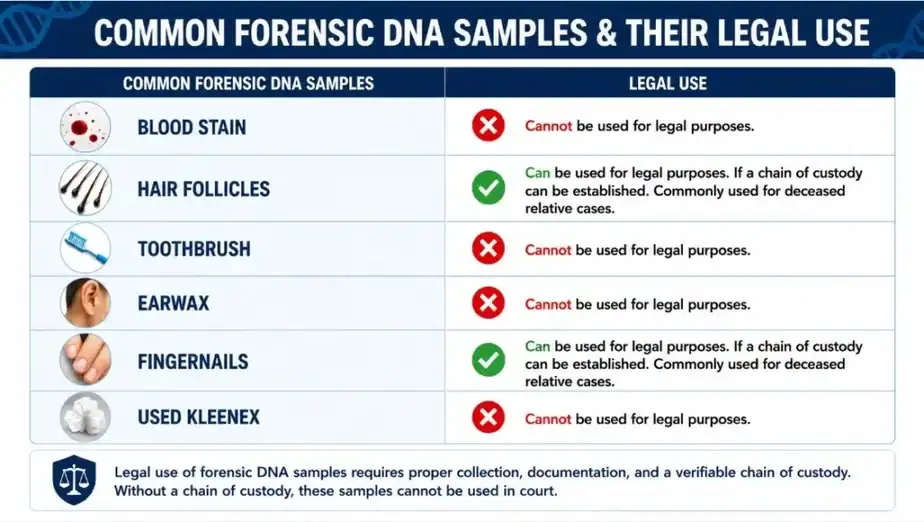
| Common Forensic DNA Samples | Legal Use |
| Blood Stain | Cannot be used for legal purposes |
| Hair Follicles | Can be used for legal purposes. If a chain of custody can be established. Commonly used for deceased relative cases. |
| Toothbrush | Cannot be used for legal purposes |
| Earwax | Cannot be used for legal purposes |
| Fingernails | Can be used for legal purposes. If a chain of custody can be established. Commonly used for deceased relative cases. |
| Used Kleenex | Cannot be used for legal purposes |
Frequently Asked Questions
How long will it take to receive my DNA results?
The turnaround time for results is 2 to 3 business days from the date the laboratory receives all DNA samples.
Are Grandparent DNA test results accurate?
Yes. Grandparent DNA testing is highly accurate when proper chain-of-custody procedures and accredited laboratory testing standards are followed. All DNA samples undergo a strict dual-analysis process to help ensure accurate and reliable results for claimed biological relationships.
All legal DNA tests are performed through our partner AABB-accredited laboratory. This accreditation helps ensure the DNA test results are recognized by family courts, immigration agencies, and government institutions nationwide.
Our partner laboratory analyzes between 18 and 22 genetic markers during the grandparent DNA testing process to determine the probability of a biological relationship. Inclusion results commonly produce a probability of relatedness of 99% or higher.
In exclusion cases, additional extended DNA analysis may be performed using up to 27 genetic markers to help determine whether the tested individuals are biologically unrelated.
Can you do a Grandparent DNA test without a parent’s permission?
No. If a child is under the age of 18 yrs old the Grandparent will need permission from the child’s parent or legal guardian.
A Grandparent can perform a DNA test with an alleged grandchild if they are an adult and the grandchild agrees to testing.
What percentage of DNA is shared between grandparents and grandchildren?
Grandparents and grandchildren share up to 25% of the same DNA.
Can a DNA Grandparent test result be used to confirm Ancestry Testing research?
Yes. A Grandparent DNA test can help confirm whether someone identified through ancestry research is your grandparent or grandchild. Please keep in mind DNA relationship tests and should not be confused with ancestry testing. DNA testing confirms relatedness while ancestry attempts to recreate a family lineage.
Remember, It is important to understand that ancestry testing and DNA relationship testing serve different purposes.
How to read grandparent DNA test results?
Understanding grandparent DNA test results begins with reviewing the genetic markers analyzed between the grandparents and grandchild. DNA laboratories examine specific genetic locations known as loci to determine whether a biological relationship may exist.
Each person inherits DNA alleles from their biological parents. During grandparent DNA testing, the laboratory compares the child’s alleles with the alleged grandparents’ alleles to identify inherited genetic patterns consistent with a biological relationship.
Understanding Positive Grandparent DNA Test Results
A positive grandparent DNA test result means the laboratory did not exclude the alleged grandparents as biological grandparents of the child. The report will normally include a Combined Grandparentage Index (CGI) and a probability of relatedness percentage.
Higher probability percentages indicate stronger genetic support for the alleged biological relationship. Most positive grandparent DNA test results show a probability of 90% or greater depending on the participants tested and whether additional family members participated in the DNA analysis.
Understanding Negative Grandparent DNA Test Results
A negative grandparent DNA test result means the genetic markers examined are inconsistent with the alleged biological relationship. Multiple genetic inconsistencies across tested markers may lead the laboratory to exclude the alleged grandparents as biological grandparents of the child.
Factors That Affect Grandparent DNA Test Accuracy
Including the biological mother in the DNA test often improves accuracy because it helps the laboratory identify which DNA markers came from the mother and which may have been inherited from the alleged biological father’s family line.
Testing both grandparents instead of one grandparent alone may strengthen the statistical analysis. Additional family members such as siblings, alleged aunts, or alleged uncles may sometimes be recommended to improve the accuracy of family reconstruction DNA testing.
Legal vs. Non-Legal Grandparent DNA Test Results
Legal Grandparent DNA testing follows a strict chain-of-custody process through an AABB-accredited laboratory. Legal results may be used for court cases, immigration matters, Social Security benefits, inheritance disputes, and other official purposes.
Non-legal Grandparent DNA testing provides the same laboratory DNA analysis but does not follow the legal chain-of-custody requirements needed for official use.
Conclusion
Carefully reviewing the probability percentage, genetic marker comparisons, and laboratory conclusion may help you better understand your grandparent DNA test results. Speaking with a knowledgeable DNA testing professional before testing may help reduce confusion and ensure the correct relationship test is selected for your specific situation.
Are my DNA results kept private?
Yes. IDTO DNA and its partner laboratory do not share any personal or genetic information with third-party companies.
All information provided to our partner laboratory is kept secure and will only be released to third parties with the explicit consent of the participants involved or by court order. Specimen samples on file are kept for an average of 3 months, then destroyed.
What factors can affect the accuracy of grandparent DNA testing?
Several factors may affect the accuracy or completeness of a Grandparent DNA test result. Understanding these factors before DNA sample collection may help reduce delays and prevent unnecessary sample recollection.
- Poor DNA Sample Storage
Improper DNA sample storage may affect DNA quality before the laboratory begins analysis. This issue sometimes occurs when individuals collect DNA samples before contacting IDTO DNA or before receiving proper collection instructions with an approved DNA test kit.
DNA samples exposed to heat, moisture, food residue, or contaminated surfaces may produce poor-quality DNA results.
- Low DNA Concentration
Low DNA concentration may occur when an insufficient cheek swab sample is collected during the DNA collection process. This situation may happen when inadequate epithelial cells are collected from the inside of the cheek.
When low DNA concentration occurs, the laboratory may produce an incomplete DNA profile and request a new DNA sample collection. Low DNA concentration is uncommon when proper DNA collection procedures are followed.
- Damaged DNA Samples During Shipping
DNA samples damaged during shipment to the laboratory may affect testing completion. Shipping carriers such as FedEx, USPS, or DHL may occasionally mishandle biological sample shipments during transportation.
Damaged packaging, excessive heat exposure, moisture exposure, or delayed transit times may require DNA sample recollection. Additional shipping costs may apply when replacement DNA collection kits must be issued.
- Limited Family Participation
Grandparent DNA testing is considered a family reconstruction DNA test. Testing only one grandparent instead of both grandparents may reduce statistical strength in some cases.
Including the biological mother, additional grandparents, or other close biological relatives may improve DNA relationship analysis and strengthen the final probability calculation.
Speaking with an experienced DNA consultant call 888-204-0583 before testing may help determine the most appropriate relationship test for your specific situation.

