Immigration DNA Testing with Grandparent Services
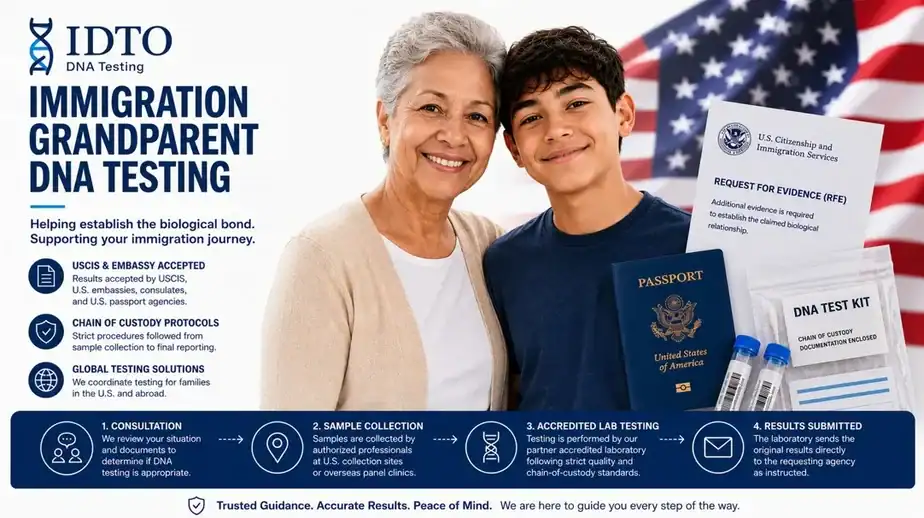
Have you recently received a Request for Evidence (RFE) letter from USCIS or the US Embassy requesting additional evidence to verify the claimed biological relationship between alleged grandparent and grandchild? This testing option may suggested when the biological parents are unavailable to participate in the testing process. IDTO will help guide the petitioner through the immigration DNA testing process while coordinating testing through our partner AABB-accredited laboratory.
All DNA testing services we provide are performed by our partner accredited laboratory. The accreditation also ensures that a proper chain of custody will be established. Testing is conducted under established chain-of-custody protocols that follow the standards required for DNA evidence submission to USCIS, U.S. embassies and consulates, and U.S. passport agencies.
Before recommending immigration grandparent DNA testing, we first determine whether DNA testing is appropriate for your case based on the documentation you have received and your current stage of the immigration process. Please keep in mind that DNA testing for immigration purposes is voluntary testing option.
Is Immigration DNA Testing the correct testing option?
Not necessarily. The first thing we need to determine is why you need the DNA test. Immigration DNA testing is designed for cases where a government agency, such as USCIS, the U.S. Department of State, or a U.S. Embassy or Consulate, requests DNA evidence to help establish a claimed biological relationship.
The key thing here is that the purpose of the test determines the process.
Before recommending immigration DNA testing, we would normally determine:
- Who requested the DNA test?
- Have you received a Request for Evidence (RFE), embassy instructions, or another official letter?
- Which family relationship needs to be established?
- Where is each participant located?
- Will the results be submitted to USCIS, a U.S. Embassy, the U.S. Passport Agency, or another government agency?
These details determine whether immigration DNA testing is actually the correct option or whether another type of DNA test would better fit your situation.
Immigration DNA testing usually becomes the appropriate choice after an official agency requests DNA evidence. That allows the AABB-accredited laboratory to follow the required chain-of-custody procedures and submit the results according to the agency’s instructions. Testing too early or choosing the wrong testing option may result in having to repeat the entire process, creating unnecessary expense and delays.
How Does The Process Work:
The immigration grandparent DNA testing process differs slightly depending on whether all participants are located in the United States or whether the beneficiary lives abroad. Below is an overview of each process.
Domestic
- After receiving a Request for Evidence (RFE) from USCIS or written instructions from a U.S. embassy or consulate requesting DNA evidence, contact IDTO DNA at 888-204-0583 to review your case and schedule your DNA sample collection appointment. We provide access to more than 3,000 DNA collection facilities nationwide, making it convenient to schedule testing near your home.
- Once your case is initiated through our partner AABB-accredited laboratory, all participants will be scheduled for DNA sample collection at one of our in-network facilities.
- Once the laboratory receives all required DNA samples, DNA analysis begins. The average turnaround time for completed DNA test results is approximately three business days from the date the laboratory receives all required samples.
- After testing is complete, the laboratory sends the original DNA test results directly to the requesting immigration authority. A copy of the results is also mailed and emailed to you for your records.
Only DNA testing performed through an AABB-accredited laboratory following strict chain-of-custody procedures is generally accepted by USCIS for immigration purposes.
International
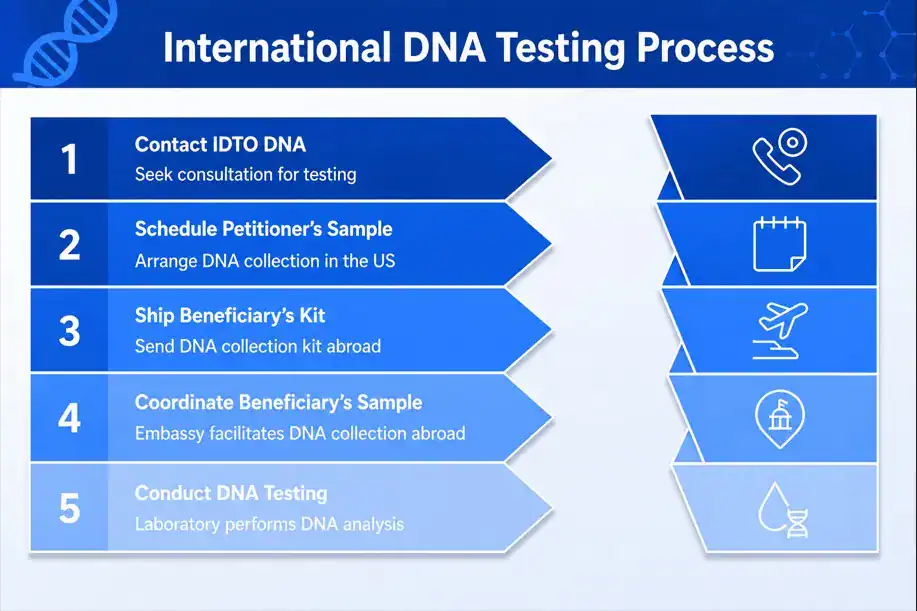
International immigration DNA testing involves a petitioner located in the United States and a beneficiary living abroad. DNA testing may be requested as secondary evidence to help establish a claimed biological father-child relationship when primary evidence is insufficient.
- To begin the process, you must first receive an I-130 Request for Evidence (RFE) or other written instructions requesting DNA evidence.
- After receiving the notice, contact IDTO DNA at 888-204-0583 for a consultation with one of our Immigration DNA Testing Consultants.
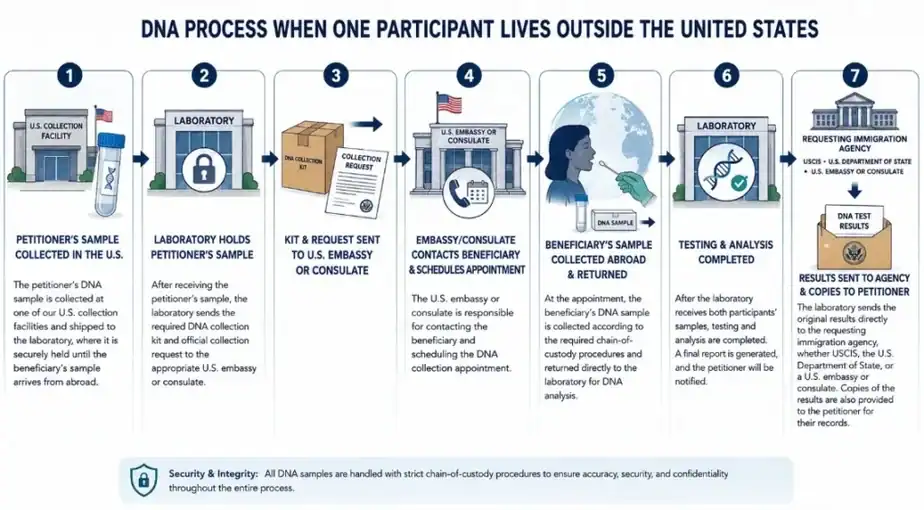
- Once your case is initiated through our partner AABB-accredited laboratory, the petitioner’s DNA sample collection appointment will be scheduled in the United States. After the petitioner’s sample has been collected, the laboratory coordinates shipment of the beneficiary’s DNA collection kit to the appropriate U.S. embassy or consulate abroad.
- The U.S. embassy or consulate will contact the beneficiary, schedule the DNA sample collection appointment, and provide the necessary instructions.
- Once the laboratory receives all required DNA samples, DNA analysis begins. The average turnaround time for completed DNA test results is approximately three business days from the date the laboratory receives all required samples.
- After testing is complete, the laboratory sends the original DNA test results directly to the requesting USCIS office or U.S. embassy or consulate. A copy of the results is also mailed and emailed to you for your records.
International immigration DNA testing cases may take several weeks or, in some cases, several months to complete depending on embassy scheduling, international shipping, and case coordination. Beneficiaries are responsible for paying all DNA sample collection fees directly to the embassy-approved collection facility at the time of their appointment.credited laboratory following strict chain-of-custody procedures is generally accepted by USCIS for immigration purposes.
Why Choose IDTO DNA?
Since 2004, IDTO DNA Testing Center has coordinated immigration DNA testing cases for many families throughout the United States and around the world. Through our AABB-accredited laboratory partner, we provide DNA test results accepted by USCIS, U.S. Embassies, and U.S. Passport Agencies.
Our DNA consultants help families understand embassy procedures, avoid ordering the wrong type of DNA test, and reduce delays caused by chain-of-custody errors. With access to more than 3,000 collection sites nationwide and decades of experience coordinating international immigration DNA testing cases, our goal is to help your case move forward efficiently and in full compliance with immigration requirements.
How Much Does Immigration Grandparent DNA Testing Cost?
Start costs for an immigration grandparent test is $650.00. Additional testing costs like international shipping and processing, and sample collection fees are not included in the cost of your DNA test. Learn more about our immigration DNA testing costs here.
Where can I go for my DNA testing appointment?
Contact our office at 888-204-0583 and allow one of our DNA Consultants an opportunity to schedule an appointment at one our over 3,000 in-network collection sites in a city near you nationwide.
Alabama
Arizona
Arkansas
California
Colorado
Connecticut
Delaware
Florida
Georgia
Hawaii
Idaho
Illinois
Indiana
Iowa
Kansas
Kentucky
Louisiana
Maine
Maryland
Massachusetts
Michigan
Minnesota
Mississippi
Missouri
Montana
Nebraska
Nevada
New Hampshire
New Jersey
New Mexico
North Carolina
North Dakota
Ohio
Oklahoma
Oregon
Pennsylvania
Rhode Island
South Carolina
Tennessee
Texas
Utah
Vermont
Virginia
Washington
West Virginia
Wisconsin
What happens after my DNA samples are collected?
Frequently Asked Questions
How long will it take to receive my DNA results?
For domestic immigration paternity testing cases, the turnaround time for results is roughly three business days from the date the laboratory receives all DNA samples. For international DNA testing cases, the turnaround time for the entire process depends on the workload of U.S. embassies or consulates and can range from several weeks to several months. Once all samples arrive at the laboratory, the turnaround time is roughly three business days.
Upon the completion of your DNA analysis, a copy of your results will be sent to the requesting immigration agency, and an additional copy will be sent directly to you by email and by physical mail.
Is Immigration Grandparent Testing Process Accurate?
Yes. Immigration Grandparent DNA testing is highly accurate when proper chain-of-custody procedures and accredited laboratory testing standards are followed. All DNA samples undergo a strict dual-analysis process to help ensure accurate and reliable results for claimed grandparent to gramdchild relationships.
All immigration grandparent tests are performed through our partner AABB-accredited laboratory. This accreditation helps ensure DNA results are prepared in accordance with evidence submission requirements that are recognized by U.S. immigration and passport agencies, U.S. embassies and consulates worldwide.
Our partner laboratory analyzes between 18 and 22 genetic markers during the grandparentage DNA testing process to determine the probability of a biological relationship. Inclusion results commonly produce a probability of relatedness of 99.99% or higher.
In exclusion cases, additional extended DNA analysis may be performed using up to 27 genetic markers to help determine whether the tested individuals are biologically unrelated.
In exclusion cases, additional extended DNA analysis may be performed using up to 27 genetic markers to help determine whether the tested individuals are biologically unrelated.
What documentation is required to perform an immigration DNA test?
To perform an immigration DNA paternity test for evidence cases, you need a Request for Evidence letter from USCIS, a request to perform DNA testing from a passport agency, a U.S. embassy, or consulate.
Performing a DNA test before receiving one of these official requests changes the chain-of-custody process and converts your case into a standard legal DNA test rather than an immigration DNA test. Because immigration DNA testing follows a different chain-of-custody procedure, we recommend waiting for the official office action requesting you submit secondary evidence before beginning the immigration DNA testing process.
Can I reuse immigration DNA test results from a previous case?
Maybe. It depends on the requesting office’s requirements. Some U.S. embassies, consulates, or immigration agencies may accept previously issued immigration DNA test results, while others may require a new DNA test depending on how much time has passed and the circumstances of your case.
Before scheduling another DNA test, we recommend contacting the office handling your case to determine whether your previous immigration DNA test results will still be accepted. If the requesting office requires new DNA evidence, a new immigration DNA testing process must be completed.
Immigration DNA Testing Appointment Form
Get Started Today and Faster Processing By Uploading Your Details Today Below.

