USCIS DNA TESTING SERVICES
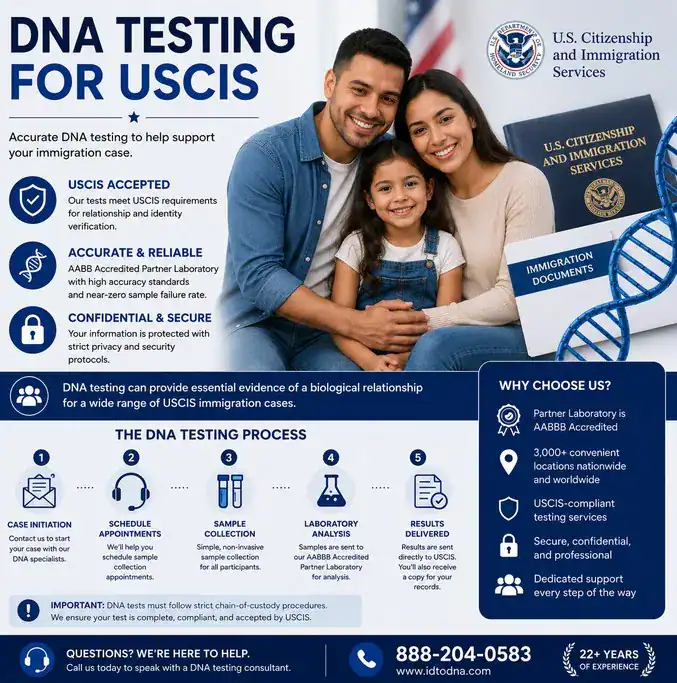
When a petitioner files an immigration petition for a relative, the primary evidence submitted to United States Citizenship and Immigration Services (USCIS) may sometimes be insufficient to establish a claimed biological relationship. In these situations, USCIS may request secondary evidence such as medical records, religious documents, or DNA testing.
IDTO DNA Testing Center provides immigration DNA testing services through our partner AABB-accredited laboratory, with results accepted by USCIS, U.S. Embassies, and U.S. passport agencies nationwide.
With over 22 years of experience and a near-zero sample failure rate at IDTO collection offices, our focus is to help ensure your case progresses efficiently and in full compliance with immigration requirements so your family moves forward, not backward.
How Does USCIS DNA Testing Work in the United States?
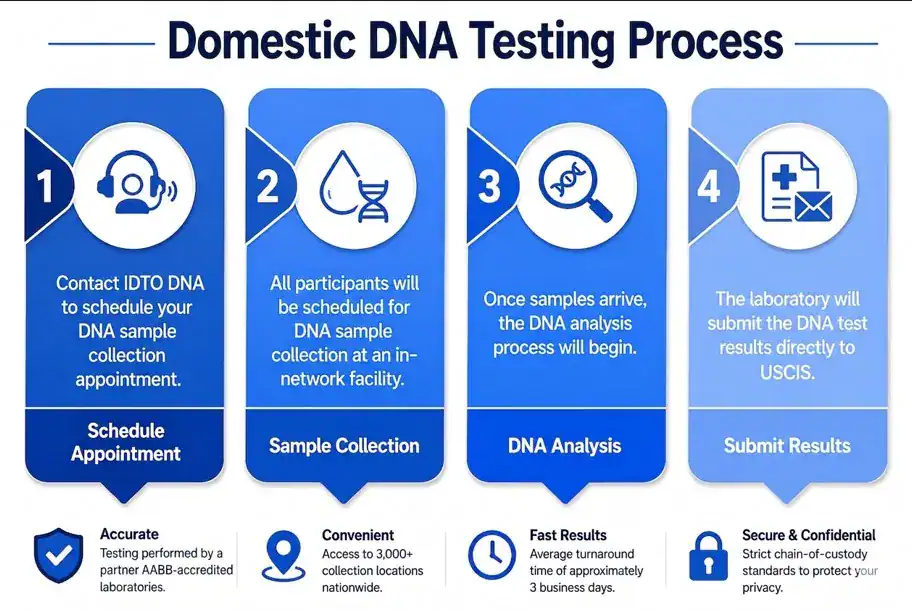
USCIS may issue a Request for Evidence (RFE) requesting secondary evidence, including DNA testing, to help establish a claimed biological relationship. The following process applies when all participants are located within the United States
- After receiving the RFE letter, contact IDTO DNA at 888-204-0583 to schedule your DNA sample collection appointment. We provide access to over 3,000 DNA collection facilities nationwide, making it convenient to schedule testing near your home.
- Once your case is initiated through our partner AABB-accredited laboratory, all participants will be scheduled for DNA sample collection at one of our in-network facilities.
- After all DNA samples arrive at the laboratory, the DNA analysis process will begin. The average turnaround time for completed DNA test results is approximately three business days from the date the laboratory receives all required samples.
- Upon completion of testing, the laboratory will submit the DNA test results directly to the requesting USCIS office. A personal copy of the results will be mailed and emailed to you for your records.
Only DNA testing performed through accredited laboratories following strict chain-of-custody guidelines is generally accepted by USCIS.
How Does International USCIS DNA Testing Work?
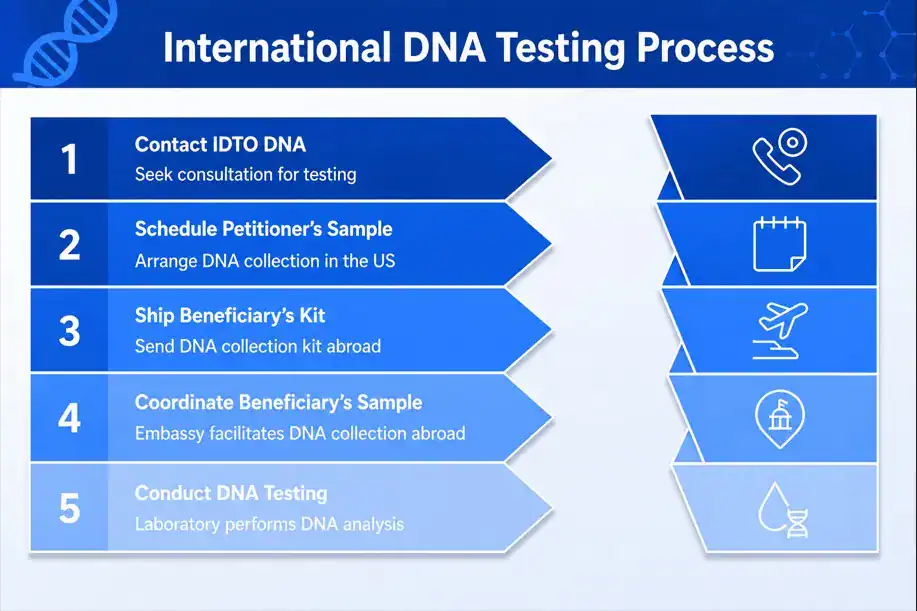
International USCIS DNA testing cases involve a petitioner located in the United States and a beneficiary located abroad. DNA testing may be suggested when USCIS requests secondary evidence to help establish a claimed biological parent-child or sibling relationship.
- To begin the process, you must first receive an I-130 Request for Evidence (RFE) letter requesting additional evidence.
- After receiving the notice, contact IDTO DNA at 888-204-0583 for a consultation with one of our Immigration DNA Testing Consultants.
- Once your case is initiated through our partner AABB-accredited laboratory, the petitioner’s DNA sample collection appointment will be scheduled in the United States. At the same time, the laboratory will ship the beneficiary’s DNA collection kit directly to the requesting U.S. Embassy or Consulate abroad.
- The embassy or consulate will coordinate the beneficiary’s DNA sample collection appointment and provide instructions by email.
- After all DNA samples arrive at the laboratory, testing will begin. The average turnaround time for completed DNA results is approximately three business days from the date the laboratory receives all required samples.
- Upon completion, the laboratory will send the DNA test results directly to the requesting USCIS office. A personal copy of the results will be mailed and emailed to you for your records.
International DNA testing cases may take several weeks to months depending on embassy scheduling and international coordination timelines. Beneficiaries are responsible for paying all DNA sample collection fees directly to the embassy-approved collection facility at the time of the appointment.
How much does a USCIS DNA test cost?
Prices start at $550.00 for parent-child DNA tests. DNA sample collection fees and multi-state shipping are not included in the cost of your DNA test. Learn more about our Immigration DNA Testing costs here.
To learn more about the cost of DNA testing as it pertains to your particular situation, please contact our office at 888-204-0583 and allow one of our DNA consultants the opportunity to assist you today.
Why Choose Us IDTO DNA?
IDTO DNA is a BBB-accredited company serving thousands of immigrant families nationwide with their genetic testing needs. Since 2004, we are partnered with an AABB-accredited laboratory to provide accurate DNA testing services with clear communication throughout every stage of your case.
Our experience and commitment to compliance have made IDTO DNA a trusted resource for both legal and medical professionals seeking reliable DNA testing services for their clients.
Our knowledgeable staff helps clients select the correct DNA relationship test for their specific situation. This guidance helps reduce testing delays, prevents ordering the wrong test, and minimizes unnecessary additional testing costs.

Where do I go to perform a USCIS DNA test?
To schedule an appointment, contact our office today at 888-204-0583. One of our DNA testing consultants will schedule an appointment at one of over 3,000 facilities nationwide in our network, located in a city near you. Below are the areas we service.
DNA Testing Locations By State
- Alabama
- Arizona
- Arkansas
- California
- Colorado
- Connecticut
- Delaware
- Florida
- Georgia
- Hawaii
- Idaho
- Illinois
- Indiana
- Iowa
- Kansas
- Kentucky
- Louisiana
- Maine
- Maryland
- Massachusetts
- Michigan
- Minnesota
- Mississippi
- Missouri
- Montana
- Nebraska
- Nevada
- New Hampshire
- New Jersey
- New Mexico
- New York
- North Carolina
- North Dakota
- Ohio
- Oklahoma
- Oregon
- Pennsylvania
- Rhode Island
- South Carolina
- Tennessee
- Texas
- Utah
- Vermont
- Virginia
- Washington
- West Virginia
- Wisconsin
DNA Testing Locations By Country
| Geographic Location | Region/Area | Countries |
|---|---|---|
| North America | Caribbean | Antigua and Barbuda; Anguilla; Aruba; Bahamas; Barbados; British Virgin Islands; Cayman Islands; Dominica; Dominican Republic; Grenada; Guadeloupe; Haiti; Jamaica; Montserrat; Saint Kitts & Nevis; Saint Lucia; Saint Martin; Saint Vincent; Trinidad & Tobago; Turks & Caicos Islands; US Virgin Islands |
| North America | Central America | Belize; Costa Rica; El Salvador; Guatemala; Honduras; Nicaragua; Panama |
| North America | North American Mainland | Canada; Mexico; United States |
| South America | Argentina; Bolivia; Brazil; Chile; Colombia; Ecuador; Guyana; Paraguay; Peru; Suriname; Uruguay; Venezuela | |
| Europe | Western Europe | Austria; Belgium; Denmark; Finland; France; Germany; Ireland; Liechtenstein; Luxembourg; Monaco; Netherlands; Netherlands Antilles; Azores; Portugal; Spain; Switzerland; United Kingdom; Vatican City |
| Europe | Eastern Europe | Albania; Belarus; Bosnia & Herzegovina; Bulgaria; Croatia; Czech Republic; Estonia; Georgia; Hungary; Kosovo; Latvia; Lithuania; Macedonia; Moldova; Montenegro; Poland; Romania; Russia; Serbia; Slovakia; Slovenia; Ukraine |
| Asia | Central Asia | Afghanistan; Kazakhstan; Kyrgyzstan; Tajikistan; Turkmenistan; Uzbekistan |
| Asia | East Asia | China; Japan; Mongolia; Okinawa; South Korea; Taiwan |
| Asia | Middle East | Armenia; Azerbaijan; Bahrain; Cyprus; Iraq; Israel; Jordan; Kuwait; Lebanon; Oman; Palestine; Qatar; Saudi Arabia; Syria; Turkey; United Arab Emirates; Yemen |
| Asia | South Asia | Bangladesh; Bhutan; India; Maldives; Nepal; Pakistan; Sri Lanka |
| Asia | Southeast Asia | Brunei; Cambodia; Indonesia; Laos; Malaysia; Myanmar; Philippines; Saipan; Singapore; Thailand; Timor-Leste; Vietnam |
| Oceania | Polynesia | Cook Islands; French Polynesia; Samoa; Tonga; Wallis & Futuna |
| Oceania | Melanesia | Fiji; Marshall Islands; Micronesia; New Zealand; Palau (Republic of); Papua New Guinea; Vanuatu |
| Africa | North Africa | Algeria; Egypt; Morocco |
| Africa | West Africa | Benin; Burkina Faso; Cape Verde; Côte d’Ivoire; Gambia; Ghana; Guinea; Guinea-Bissau; Liberia; Mali; Mauritania; Niger; Nigeria; Senegal; Sierra Leone; Togo |
| Africa | East Africa | Burundi; Djibouti; Eritrea; Ethiopia; Kenya; Lesotho; Madagascar; Malawi; Mauritius; Mozambique; Rwanda; Seychelles; Somalia; South Sudan; Tanzania; Uganda; Zambia; Zimbabwe |
| Africa | Central Africa | Cameroon; Central African Republic; Chad; Congo (Democratic Republic); Congo (Republic of); Equatorial Guinea; Gabon |
| Africa | Southern Africa | Botswana; Namibia; Reunion Island; South Africa; Swaziland |
Frequently Asked Questions
How long does it take for DNA test results to be processed?
The average turnaround time for results is three business days from the date the laboratory receives all DNA samples.
For international DNA testing, the turnaround times also include the sample collection process abroad, which may take several weeks to several months. Once the sample is collected abroad, it will be sent back to the laboratory for comparative analysis. Comparative analysis takes roughly three business days.
Does USCIS require DNA Testing to be performed?
No, DNA relationship testing is a voluntary option for petitioners and beneficiaries when they fail to provide sufficient evidence to support their claimed biological relationship while applying for an immigrant visa. It is considered a secondary option by USCIS, and it is not advisable to conduct genetic testing prior to receiving a Request for Evidence (RFE) from USCIS.
When is DNA Required for Immigration?
DNA testing is suggested by immigration officials when there is insufficient primary evidence to prove a biological relationship in an immigrant visa application. This usually occurs when USCIS or a U.S. Embassy consular officer deems the submitted evidence inadequate.
Can I perform a DNA test before I receive my I-130 RFE letter?
Petitioners considering DNA testing before receiving an I-130 Request for Evidence (RFE) letter should understand that doing so does not follow USCIS or U.S. Embassy immigration DNA testing chain-of-custody guidelines.
DNA testing performed before an official request is issued is considered a standard legal DNA test. Results submitted independently by the petitioner generally do not meet immigration evidence submission requirements established by USCIS and U.S. Embassies.
Please keep in mind that both the petitioner and beneficiary must be located within the United States to perform a standard legal DNA test during the immigration process.
In international immigration DNA testing cases, U.S. Embassies and Consulates will not coordinate a beneficiary’s DNA sample collection appointment abroad without an official USCIS Request for Evidence letter.
We recommend waiting until USCIS issues the RFE notice to help ensure your family follows the proper immigration DNA testing procedures required for evidence submission. Following the correct chain-of-custody process helps maximize acceptance by USCIS, U.S. Embassies, and other government agencies.
How Will My DNA Samples Be Collected?
The standard method of DNA sample collection is performed using a painless cheek swab. This collection method is fast, non-invasive, and highly accurate for DNA relationship testing.
Blood sample collections provide the same level of accuracy as cheek swab samples. However, blood collection methods are more invasive, more expensive, and are generally only recommended under unique testing circumstances.
Can an At-Home DNA Test results be used for immigration purposes?
No. Home DNA Tests are for informational purposes only and cannot be used for immigration purposes because Home Tests do not meet embassy chain of custody standard guidelines.

