
Signs Your Not The Biological Father
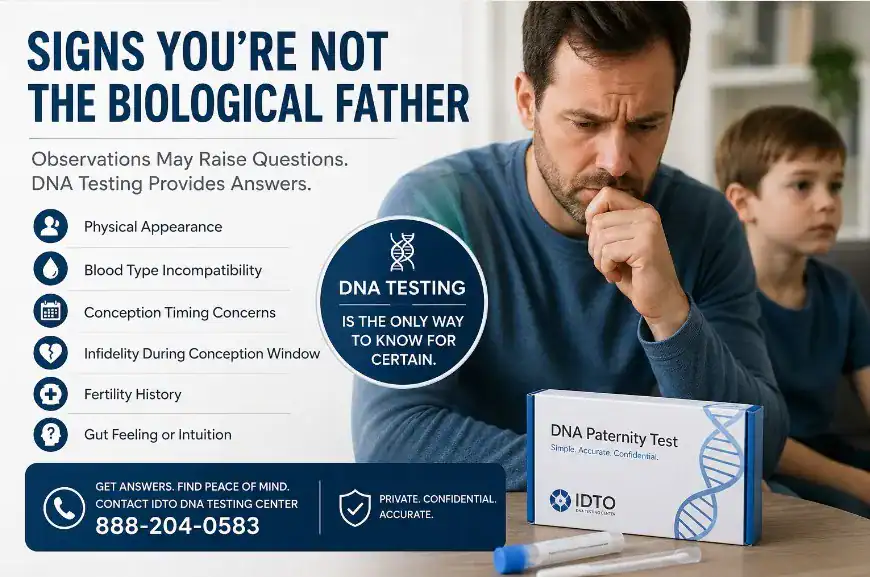
Why Do Men Begin To Question Paternity?
Since coordinating relationship DNA testing cases since 2004, we’ve found that paternity doubts usually begin because something appears inconsistent rather than because a person has scientific proof.
In some situations, men question paternity because the timing of conception and birth does not seem to align with what they were told. In other cases, concerns arise after relatives, friends, or other family members repeatedly suggest that a child does not resemble the alleged father. Physical differences, comments from others, or conflicting timelines often create uncertainty and emotional stress.
Over the years, we have encountered situations where those concerns ultimately proved to be correct and other situations where the alleged father was, in fact, biologically related to the child. While these observations may raise legitimate questions, they do not provide definitive answers.
DNA testing remains the most reliable method for determining whether an alleged father is biologically related to a child.
Common Signs People Notice:
Can Physical Appearance Raise Questions About Paternity?
A child who doesn’t resemble the alleged father or his side of the family is often the first thing people notice. It’s also one of the weakest indicators children inherit traits unpredictably across a wide gene pool, and a child can favor a grandparent or distant relative and look nothing like either parent purely by chance.
Can Blood Type Suggest Someone Is Not The Biological Father?
Certain parent-child blood type combinations are genetically impossible, which makes this the one circumstantial method with real evidentiary weight. The catch: it only works in the ruling out direction. A compatible blood type never confirms paternity, and most people don’t have the lab knowledge to evaluate this without testing anyway.
Can Conception Timelines Raise Questions About Paternity?
Awareness of a conception window that doesn’t match known contact, travel, or periods of separation can be a meaningful prompt but memory and assumptions about fertile windows are often wrong.
Can Infidelity Raise Questions About Paternity?
Knowledge or suspicion of infidelity during the likely conception period is one of the most common reasons people seek paternity testing. However, suspicion alone cannot determine whether an alleged father is biologically related to a child.
DNA testing remains the most reliable method for establishing a biological relationship
Can fertility history cause questions about paternity?
Yes. A known diagnosis of male infertility (low sperm count, prior medical findings) can lower the probability of conception — but lower probability is not impossibility.
Can A Gut Feeling Indicate Someone Is Not The Biological Father?
Uncertainty and intuition are real emotions, but they do not provide evidence of paternity. In our experience, some men seek testing because they have an unexplained feeling that something is wrong. While those concerns may ultimately prove justified or unfounded, intuition alone cannot determine whether an alleged father is biologically related to a child.
Doubt may be a reason to seek answers, but it should never be considered proof. DNA testing remains the most reliable method for establishing a biological relationship.
Why None of These Signs Are Proof?
Every item on this list shares the same weakness: it suggests possibility, not certainty. Resemblance is genetically unreliable. Timelines can be misremembered. Even fertility issues don’t rule out conception. People have made life-altering decisions based on these signs ending relationships, denying support, walking away from a child only to learn after testing that they were wrong, in both directions.
Need a Definitive Answer?
Physical appearance, blood types, conception timelines, and family opinions may raise questions, but they cannot provide certainty. DNA testing remains the most reliable method for determining whether an alleged father is biologically related to a child.
Whether you need a private peace-of-mind test or legally admissible results for child support, custody, or other legal matters, our DNA consultants can help you determine which testing option best fits your circumstances.
Contact IDTO DNA Testing Center at 888-204-0583 to discuss your situation or schedule a DNA testing appointment.
The Only Way to Know for Certain
DNA testing is the only method that examines biological reality directly. A standard paternity test compares genetic markers between the alleged father and child and returns a result with no meaningful gray area: typically a 0% probability (exclusion) or 99.9%+ probability (inclusion). It doesn’t matter what the child looks like, when conception occurred, or who else was involved — the genetic markers settle the question.
Modern DNA testing only requires a simple cheek swab and results are typically available within a few business days. Whether you need a legal DNA test or a private peace-of-mind test, IDTO DNA can help guide you through the process.
Contact IDTO DNA Testing Center at 888-204-0583 to discuss your circumstances and determine which testing option best fits your specific situation.
Frequently Asked Questions
Can resemblance alone confirm or rule out paternity?
No. Resemblance is suggestive at best. Children can look entirely unlike a biological parent, or strongly resemble a non-biological one, due to the wider gene pool of extended family.
Can Conception Dates Help Determine Paternity?
Conception timelines may raise questions about paternity, but they cannot establish paternity by themselves.
In our experience coordinating DNA testing cases, some alleged fathers seek testing because the timing of conception, pregnancy, or birth appears inconsistent with what they were told. In certain situations, a child may be born prematurely, while in others, the pregnancy timeline may cause the alleged father to question whether he could be the biological parent.
Although timing may create legitimate concerns, pregnancy dates alone cannot determine paternity. DNA testing remains the only scientifically accepted method for establishing a biological relationship.
Can Family Members Be Wrong About Paternity?
Yes. Friends and relatives sometimes influence a person’s beliefs about paternity. Comments about a child’s appearance, skin tone, facial features, or resemblance to other family members can create doubt and cause an alleged father to question whether he is biologically related to a child.
In our experience, we have seen situations where family concerns proved to be justified and other situations where DNA testing confirmed that the alleged father was indeed biologically related to the child. Because physical appearance and opinions are subjective, they should never be considered proof.
DNA testing remains the most reliable way to determine whether a biological relationship exists.
Does a matching blood type confirm paternity?
No. Blood type can only rule someone out in certain incompatible combinations it can never confirm paternity on its own.
If I have doubts, what should I do first?
The most direct path is a DNA paternity test. It removes guesswork entirely and provides a legally recognized result if one is needed for custody, child support, or other legal matters.
How accurate is DNA testing compared to these signs?
DNA testing returns statistical certainty (99.99%+ or 0%), while every other method discussed here only raises or lowers suspicion without ever confirming an answer.

